what is hockey even about?
hello there! this carrd is a friendly, easy-to-understand introduction to the best sport in the world (totally not biased).are you curious to get to know more, but don't know where to start? or perhaps the sheer amount of technical details and statistics overwhelms you? don't worry! this guide contains only the basics you need to know in order to follow along while watching a game!use the navigation below to start learning ☻
the structure of a hockey game
a hockey game (typically) lasts 60 minutes and is divided into three periods, each 20 minutes long. between each period, there is an intermission, allowing the players to rest and regain energy.the point of hockey is very simple; the team that scores more goals by the end of the 60 minutes, is the winning team. if the score is tied after 60 minutes, the tie breaker is decided in overtime.*
*although not essential to understanding hockey generally, i highly recommend reading this section of the page, as overtime can happen pretty frequently throughout a season.
the typical 60 minutes of play is referred to as regulation time. if the score is tied after regulation time, overtime is required to break the tie.in the regular season, overtime goes as follows: a small 5 minutes long period is disputed between both teams, and if the score is still tied, shootout rounds ensue.a shootout is when each team alternatively sends out a skater to shoot one-on-one against the opposing goaltender. the team with the most goals after the allotted shootout rounds wins the game. if the score is still tied, the shootout continues in a sudden-death format, until a winner is decided.
the structure of a hockey team
an average hockey team is comprised of 20 players, with up to 23 allowed in total. roster is a term that is commonly used to describe a team. it refers to the list of players that are available to play during the season (or a specific game).typically speaking, a roster is made up of 12 forwards, 6 defensemen & 2 goaltenders (one of which acts as a backup to the primary goaltender). you can learn more about the different positions and roles of a hockey player in the positions tab, in the navigation.
positions in hockey
forwards
a forward in hockey is usually responsible for scoring goals and producing offense during a game. although any player is allowed to score goals (yes, even goalies!), that role is usually the responsibility of a forward.*
*the forward position is divided into three subpositions. if you are completely new to hockey, you do not have to worry about learning each technical roles these subpositions imply, but i will still go over the basics.
a forward can be either a left winger, a center, or a right winger. these names are somewhat self explanatory in terms of physical on-ice placement. wingers are usually positioned along the sides of the ice rink, to support the center.the center is usually regarded as the most versatile player in a formation. they are also responsible for taking faceoffs. (learn more about terms like this in the vocabulary tab!)
defensemen
defensemen, as the name suggests, are in charge of defending their zone. they are the last line of protection before the goalie. they are responsible for stopping the opposing team from scoring goals. a defenseman seeks to reduce pressure on their goalie by either blocking shots or stopping the opposing team from reaching the net in the first place.
goaltenders
a goaltender is in charge of protecting the net and stopping the puck from going in. they are the very last barrier of protection and must ensure to keep the puck from going in, in the case where the defensemen fail at keeping the puck away.this is probably the most straightforward position in hockey, as there isn't much else a goaltender does during a game.
the basic rules of hockey
there are rules in hockey that define how the game can be played and limitations to what actions players are allowed to do. there are certain events during a game that can cause a stoppage of play without resulting in a penalty. this section will go over the most common of these events.situations marked with * are subject to exceptions and may result in penalties depending on certain factors and the context. check out the penalties section of this guide for more details!
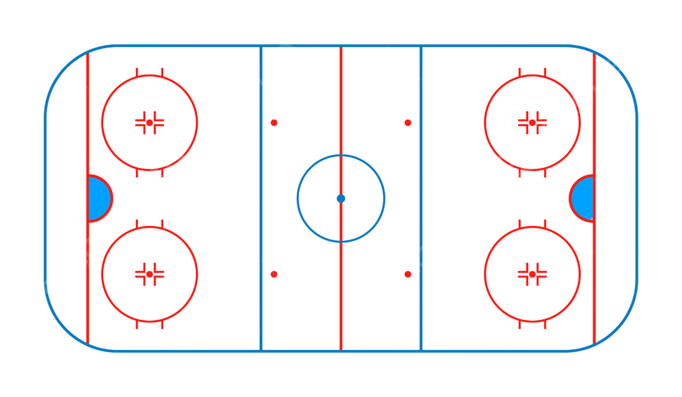
this is a hockey rink. the definitions below will mention specific zones in the rink. refer to this image to better understand the definitions!
offsides
an offside is called when an attacking player crosses the opposing team's blue line before the puck does. a linesman will blow the play dead, and a faceoff will take place at one of the 4 red dots in-between the neutral zone (the zone between the two blue lines), usually on the side of the rink where the offside ocurred.
icing
an icing is called when a player shoots the puck from their own zone, past the opposing team's goal line, without the puck being touched by another player during the puck's travel. there are factors that can influence whether an icing is ruled off or not, but for the sake of keeping it simple this guide will not go over these technical factors. when an icing occurs, the play is blown dead by a linesman and a faceoff occurs in the zone of the team that iced the puck. that same team is also not allowed to proceed to a change of players on the ice.if this explanation doesn't make sense, don't worry! icing is kind of a difficult concept to understand at first, and it's something you will eventually understand the more you watch hockey.
high stick*
when a player touches the puck with their stick higher than shoulder height, the play is blown dead and a faceoff will occur where the high sticking happened.
puck exiting the rink*
when the puck leaves the rink bounds, the play is blown dead and a faceoff will occur. this includes the puck flying out across the glass panes and into the crowd, or the puck touching the protective netting at each end of the rink.
goals
when a goal is scored by one of the teams, the play is blown dead and a faceoff occurs at center ice.
injuries*
when a player is injured and unable to continue playing or exit the ice by their own means, the play will be stopped by the referee to allow the player to receive medical attention.
basic penalties in hockey
a penalty is an infraction caused by a player during a game. when a penalty is called, the penalized player is sent into a "timeout" and is forced to sit out of play for a determined* period of time. as a result, the penalized player's team is shorthanded, meaning they are forced to play with one less player than usual for the duration of the penalty, while the opposing team is said to be on a power play.there are a lot of different penalties, and some happen more often than others. for simplicity, i will only go over the most common penalties that get called.
*penalties are divided into a few categories, which influence the duration of the penalty as well as potential additional consequences. there are minors, double-minors, majors, game misconducts and match penalties. i will not go in details about what category each penalty fits into, for the sake of simplicity.
high sticking
this penalty is called when a player hits (often by accident) an opposing player in the face with their stick.the duration of the penalty is doubled when the other player is bleeding as a result.
hooking
this is called when a player deliberately uses their stick in a way that restrains an opposing player's movement.
holding
this is essentially the same as hooking, but instead of using their stick, the offending player uses their hands to grab the body or equipment of an opposing player in a way that restrains movement.
tripping
a tripping call is pretty self explanatory. it is called when a player trips an opposing player in any fashion, including using their stick.depending on the context, especially if the opposing player is tripped while on a breakaway, a tripping penalty can be upgraded to a penalty shot awarded to the tripped player.
cross checking
this is called when a player intentionally checks an opponent by using the shaft of their stick. if it's judged by the referee as a deliberate attempt to injure, the consequences can increase.
boarding
this is called when a player violently pushes, trips or checks an opponent head-first into the boards. once again, if judged as an attempt to injure, the consequence can be increased.
delay of game
this penalty is called under a few different circumstances.a) when a player shoots the puck out of play from their defensive zone or neutral zone (intentionally or not).b) when a player deliberately moves their own net out of position.c) the other team challenges a goal, and the challenge is unsuccesful. the challenging team will automatically be asserted a delay of game.
too many men/women
this penalty is called when a team is caught with more players than the legal number of players allowed at a time on the ice (in hockey, that number is 6 per team including the goaltender). this penalty is usually the result of a badly executed line change, where the player entering, or exiting the ice plays the puck while the other is on the ice.
roughing & fighting
roughing is called when two players engage in a minor altercation.fighting is called when the players take off their gloves and engage in a fist fight.
hockey lexicon!
okay, let me step out of my formal character for a minute. hockey has a very, very long list of terms as well as slang words. listing them all here would literally take forever and like, no offense, but i cannot be bothered do that lol, so i will only go over some of the words used in this guide + some extrasif you want to familiarize yourself with all the different terms, wikipedia has a glossary of that.
(click on the underlined text to be redirected!)
quick glossary
regulation time
the normal length of a game.
overtime
additional time required when the score is tied at the end of regulation time.
shootout
another form of overtime, required when an OT period isn't enough to break the tie. players shoot one-on-one against the opposing goalie until a winner is decided.
roster
list of players available and ready to play in games.
faceoff
the method used to start a period, or resume playing after a stoppage of play, where two opponents face each other and fight for control of the puck dropped between them by a referee.
shorthanded
refers to a team having fewer players on the ice as a result of a penalty.
power play
the team possessing a numerical advantage in players as a result of a penalty asserted to the other team.
goal
when the puck fully crosses the goal line into the net, it is referred to as a goal, or "scoring a goal". a player is credited with a goal when they are the very last player to make contact with the puck before it crosses the opposing team's goal line.
assist
an assist is attributed to the last or two last players who made contact with the puck before the player who was credited with the goal.
rookie
refers to a new player competing in their first ever game/season of pro hockey.
where to watch the NHL
there are a few different ways to watch hockey, some more affordable & accessible than others.
IF YOU LIVE IN NORTH AMERICA:
Canada
TSN *, Sportsnet, CBC (english)
RDS *, TVA Sports (french)
* regional games. these games are available to watch for subscribers located within the team’s broadcast region. blackouts outside the covered broadcast region apply.
USA
ABC, ESPN, TNT, TBS, NHL Network
as i am a canadian, i am less familiar with broadcasters outside my country. if i missed some or you'd like me to specify if regional blackouts apply, let me know!
IF YOU LIVE ELSEWHERE IN THE WORLD:
click on this link and look for your country in the list
IF YOU LIVE ANYWHERE AND YOU HATE PAYING FOR SHIT:
install a good adblocker, keep your antivirus updated and use this website
i have never had major issues with this site other than annoying popup ads (which usually don't appear if you have a good adblocker), but as with all illegitimate streaming sites, it is always good to practice basic internet safety!
women's hockey
this guide primarily covers the NHL (National Hockey League), which is considered the highest level of men's hockey in the world.however, most of what is covered in this guide also applies to the PWHL (Professional Women's Hockey League), a recently formed women's hockey league which serves as the women's hockey counterpart of the NHL in terms of skill level. the PWHL rulebook varies slightly from the NHL rulebook, and i encourage you to not only check out the PWHL, but to also familiarize yourself with the structure and rules of the league. you can view the beginner's guide to the PWHL here!
where to watch the PWHL
the PWHL is a lot more accessible to watch than the NHL. in fact, you can literally watch games live for free on youtube!*
*not applicable for canadian residents. unless... y'know, you get a VPN or something lol
OTHER WAYS TO WATCH THE PWHL:
Canada
CBC/Radio-Canada (saturday), TSN/RDS, Amazon Prime Video (tuesday nights)
RDS and Radio-Canada cover Victoire games in french.
USA
NESN (new england), Fanduel Sports Network (minneapolis/st. paul), MSG Network (new york)alternatively, free live streams of games on the official PWHL youtube channel are accessible to USA residents outside of the local broadcast areas.
broadcast partners for the newly added seattle team have not yet been announced.
Elsewhere in the world